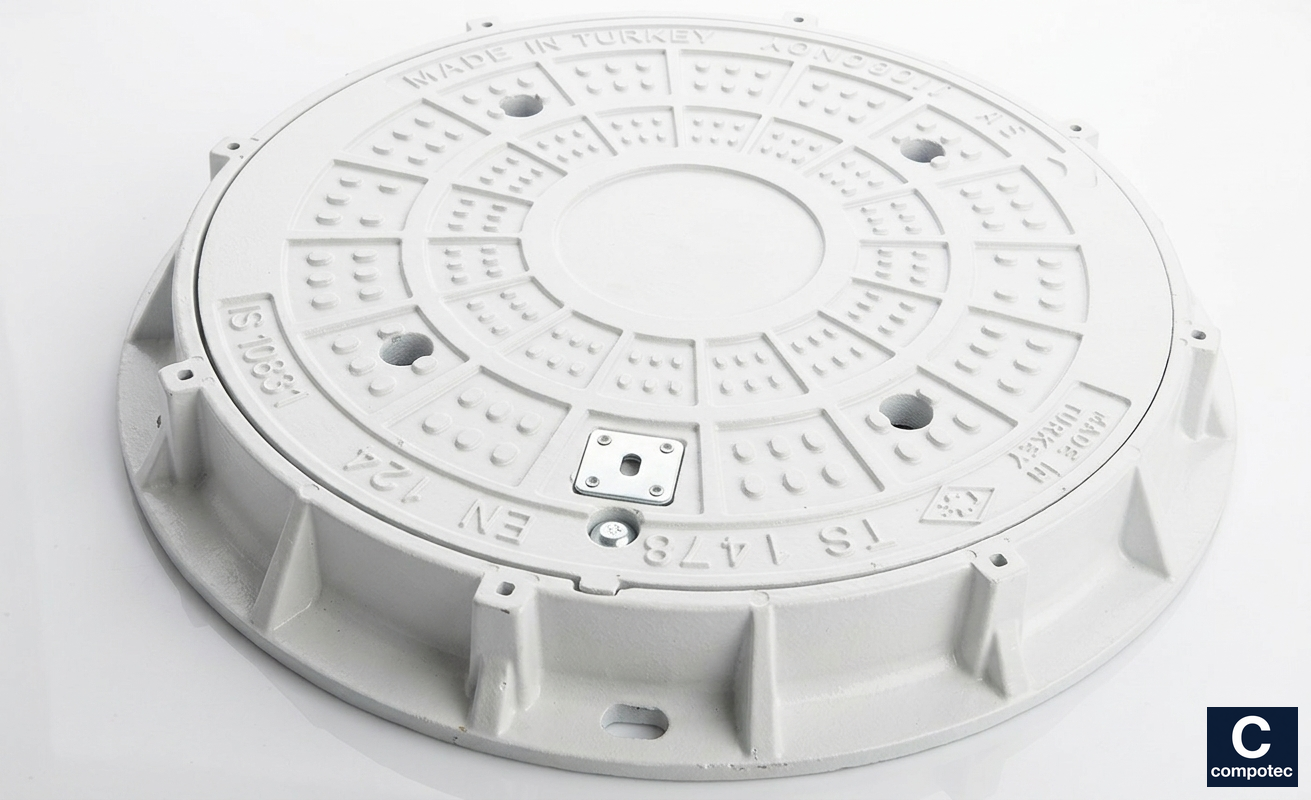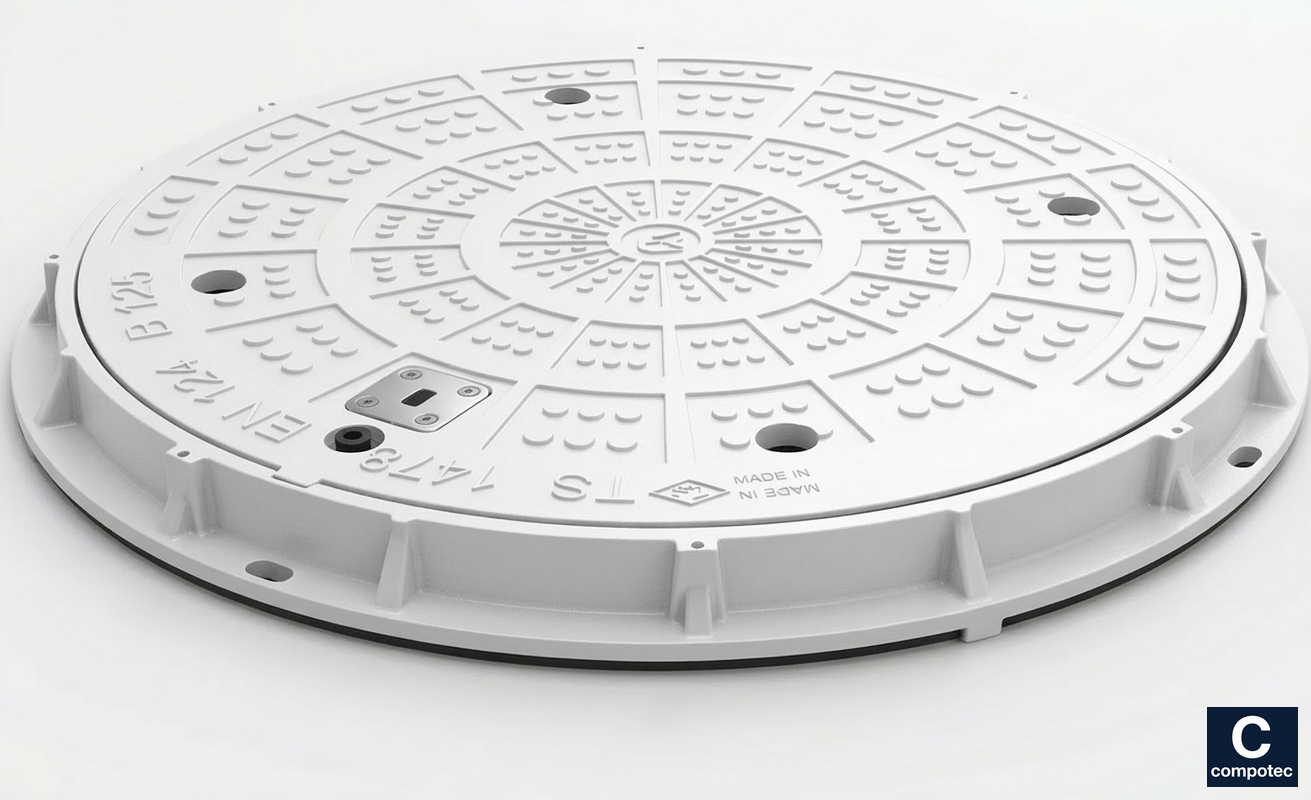
D400 Composite Manhole Covers: What They Are and Where They Are Used
D400 is the load class for carriageways and hard shoulders. Here is what that means in practice and which Compotec composite models are available in it.
D400 is the class most often written into municipal and highway specifications, and the one most often misapplied. It defines a 400 kN test load and covers installation points used by all vehicle types. This article explains where D400 belongs, what changes on site when a chamber sits in a traffic lane, and which Compotec composite covers are offered in this class.
What D400 covers
D400 applies to carriageways, hard shoulders and parking areas used by all vehicle types, including heavy goods vehicles. In practice this means any chamber inside the trafficked width of a road, at a junction, in a bus lane, at a logistics yard entrance or in an industrial access road.
The class is defined by the test load of 400 kN. It is a design and verification reference for the complete cover and frame, not a statement about a single component.
Why composite is used at D400
Road chambers are the hardest place to justify a corroding material. Water, de-icing salt and wastewater all reach the frame seating, and every corrosion cycle loosens the seating and starts the cover rocking under traffic.
Composite does not corrode, so the seating geometry stays as installed. Compotec states its composite covers as three times lighter than the metal versions, which matters for a road chamber because reinstatement after maintenance happens under traffic management with a limited crew and a limited road closure window.
Composite also has no scrap value. A stolen road cover is an open shaft in a traffic lane, and removing the resale incentive removes that risk.
Compotec D400 models
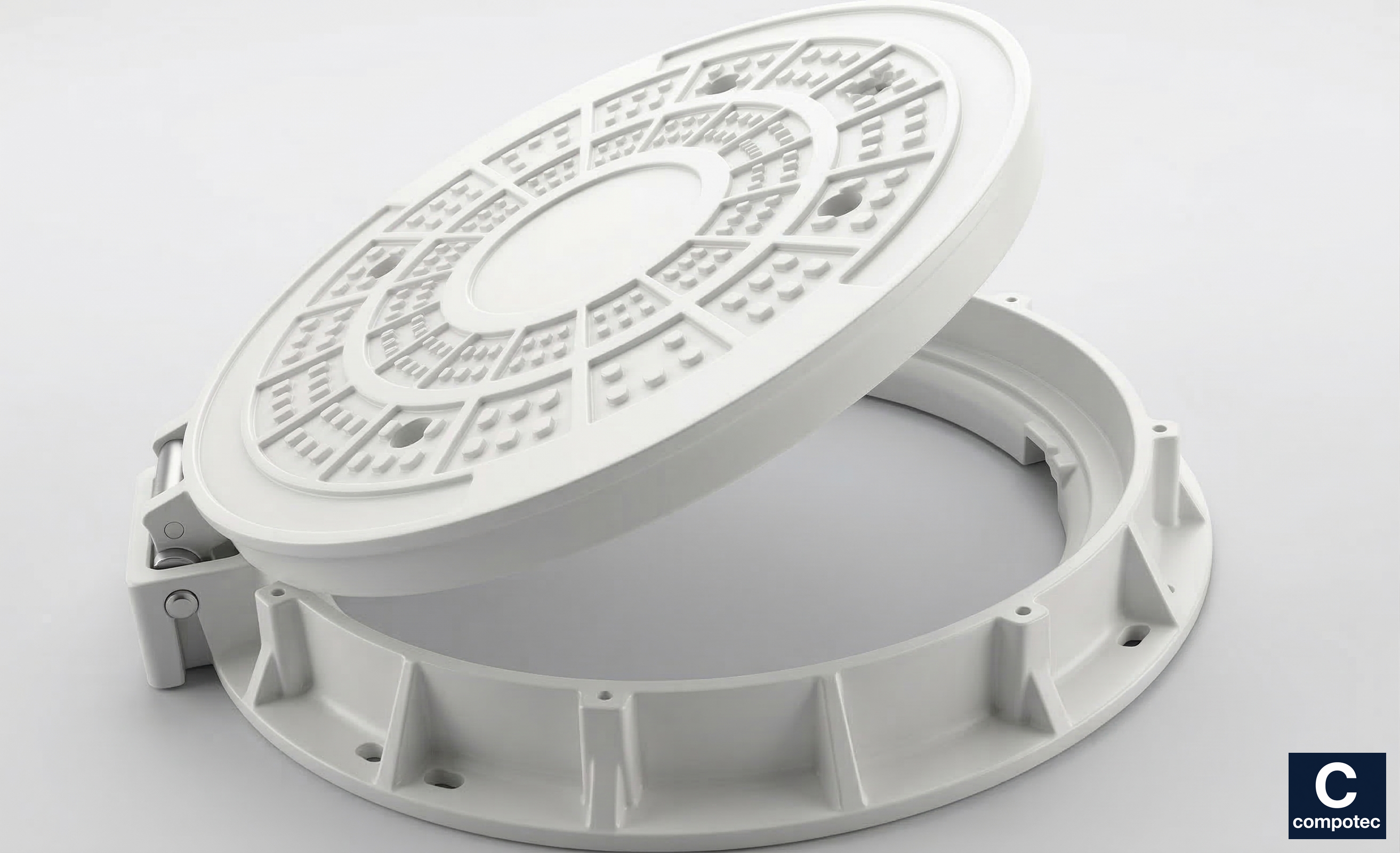
MH-100 — Ø 600 mm round, jointed hinge system, opens to 180°, 44 kg.
MH-200 — Ø 550 mm round, jointed hinge system, 38.5 kg.
MH-300 — Ø 600 mm round, hingeless and fully removable, 41 kg.
MH-301 — Ø 600 mm round, hingeless lightweight version at 23 kg.
MH-400 — 500 x 500 mm square, opens to 200°, 18 kg.
Each model page lists its full specification, available classes, ventilation, locking and gasket configuration.
Specifying a D400 chamber correctly
Confirm the clear opening the maintenance work actually needs before fixing the model, because a cover cannot be enlarged later without rebuilding the chamber head.
Check the frame footprint against the chamber structure and the surrounding surface build-up so the cover finishes flush with the running surface.
Decide hinged or hingeless: hinged keeps the cover attached during maintenance in live traffic, hingeless gives an unobstructed opening.
Record the locking and gasket requirement, and any colour or logo application required by the client.
Where D400 is not required
Over-specifying every chamber to D400 is not a neutral decision: it fixes the model choice, the frame footprint and the unit weight. Footway chambers set back from the kerb are normally B125, and kerbside and gutter positions are normally C250. Use D400 where the traffic justifies it and record why.
D400 is a location decision, not a default. Confirm the traffic at the installation point, choose the model from the clear opening it has to serve, and check the class on the product page before the order is placed.