Polymer Channels with Cast Iron Grates: Specifying Linear Drainage
When linear drainage beats point drainage, how to read the DD series widths and heights, and what belongs in a channel specification.
Point drainage collects water at a gully; linear drainage intercepts it along a line. On forecourts, ramps, pedestrian squares and parking areas, a channel usually solves in one run what would otherwise need several gullies and a network of connecting pipes. This guide explains how the Compotec DD polymer channel range is structured and what to confirm before ordering.
Where a channel is the better answer
A channel is the natural choice where water arrives across a surface rather than at a low point: entrance aprons, ramp bases, parking bays, landscaped areas and squares laid to a shallow fall.
It also reduces excavation. One channel run laid to the surface fall removes the need to shape the paving into multiple local low points, which is often the part of the job that fails first.
How the DD series is organised
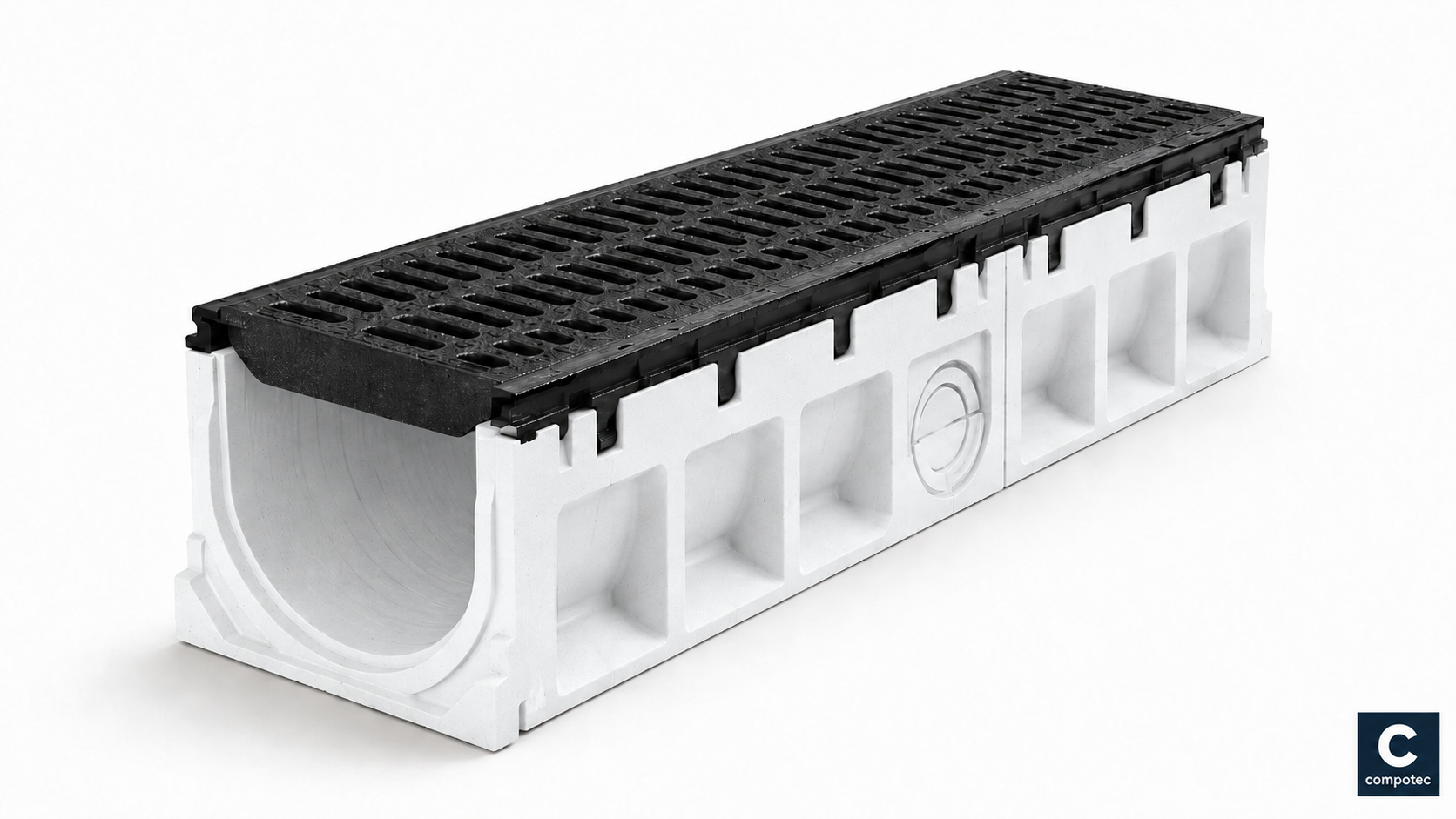
The range is grouped by channel width. DD 400 is 125 mm wide, DD 401 is 200 mm, DD 402 is 250 mm, DD 403 is 300 mm and DD 404 is 400 mm. Every unit is 1000 mm long, so run lengths are set by the number of units.
Within each width, the number after the dash is the channel height in millimetres — for example DD 401-150 is a 200 mm wide channel, 150 mm high. Heights range from 60 mm for shallow build-ups up to 400 mm where more capacity or a deeper invert is needed.
Choosing width and height
Width follows the surface area draining into the run and the grate opening you need; height follows the flow to be carried and the depth available above the sub-base and any services.
Where the build-up is shallow — over a slab, a basement roof or an existing structure — start from the height that fits and increase the width rather than forcing a deeper channel into a depth that does not exist.
Polymer body, cast iron grate
The channel body is polymer: light to handle on site, dimensionally stable and resistant to water, chemicals and outdoor exposure. The grate is cast iron, giving a hard-wearing top surface where wheels and foot traffic actually make contact.
This pairing puts each material where it performs: the body stays in permanently wet ground without corroding, while the visible wearing surface is metal.
What to confirm before ordering
Confirm the run length in whole 1000 mm units, the width and height per section, the fall arrangement, the outlet position, and how the channel is restrained in the surrounding construction.
Also confirm the traffic over the run. Where vehicles cross a channel, the loading expectation should be stated at enquiry stage so the correct configuration is agreed rather than assumed.
Linear drainage is specified from the surface it protects: the water arriving, the depth available and the traffic crossing it. The DD product pages list the width, height and length of every section so a run can be scheduled exactly.